
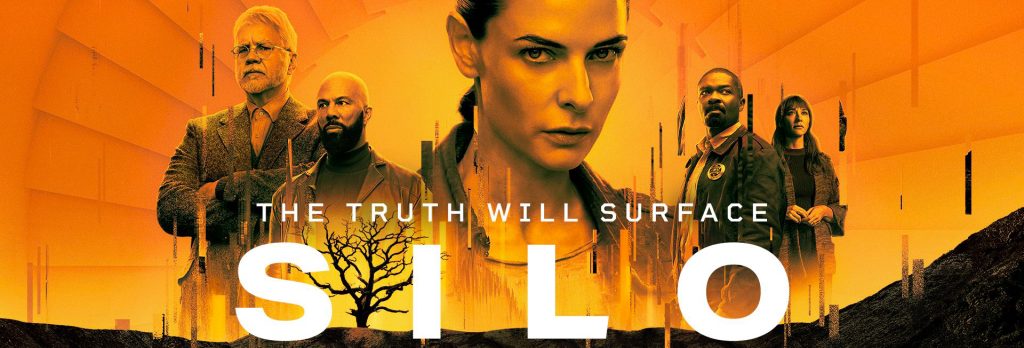
Adapting a novel into film or TV requires a ton of decisions. What parts of the book are most important? How can we reduce the cast size, or the number of locations, or do things practically or with effects to meet a budget. Things have to change for the new medium. But there are a few things that should never change.
The most important of these is your main character. There are a ton of reasons readers fall in love with a story, but this is the beating heart of that relationship. You’ve got to nail your protagonist. With SILO, we hit the bullseye on day one by landing Rebecca Fergusson. But it wasn’t just signing her on as an actor — she declined the offer at first. It was when she came back with questions about Juliette — what made her tick, what made her different — that we knew we were in good hands. Apple hired Rebecca on as a producer, and she and I spent days getting to the core of Juliette’s character.
The other thing you can’t mess up is theme. What’s this story about? Why will people be interested? Why does it need to be told? Getting this right came down to Graham Yost and the writing team. Graham took on SILO as a big fan of WOOL. He’d been chasing the project for almost ten years, going back to when we did a deal with Ridley Scott. Throughout the process, as we made decisions to veer from the books or reign it back in, Graham was constantly discussing what these stories were about at the very root. Which is why I think a reminder is important.
The original short story WOOL, and the novel it would become, were largely inspired by a rather sad observation: history repeats itself. Every generation seems to need to make the same mistakes the previous generation made. War, market crashes, totalitarian populism, environmental disaster, investment bubbles, housing booms and busts, revolutionary uprisings — each time there’s a mantra that “this time is different,” but it rarely is. George Orwell wasn’t prophetic, he was writing about history. We’re just dumb enough to keep making him relevant.
When I wrote the original short story, I had an idea that these revolutions occurred every twenty years. Long enough for people who weren’t alive during the last fight to take up arms. About a year before I wrote WOOL, I came across a well-known story about Albert Woolson, the last living veteran of the Civil War. Woolson was born in 1850. He died in 1956 at the age of 106. He’s pictured here with his granddaughter, who would be in her late 70s today:

Three generations can span from today to the Civil War. And yet it feels like ancient history, as if it only happened in books, not in real life. Like the events that led to it were unique and could never happen again. In WOOL, I put the uprising that changed the course of history within the silo about 150 years into the past. This was far enough that nothing about the time would survive. WOOL for me was largely a story about repeating our mistakes because we are terrible at knowing their causes or remembering the lessons others learned.
As the short story grew into a trilogy, I explored this theme in greater detail. Around the time I sat down to write SHIFT, there was a cover story on a popular science magazine about a new use for Propranolol in helping people forget traumatic events from their past. A pill for forgetting. It worked so well with the theme of the short story that I made it a central feature of SHIFT. That pill is our ignorance, our stubbornness. It will play a role in season three of SILO, which debuts in less than a week.
Stay with us as we explore this theme, because it’s one of the reasons the story was written in the first place. And don’t fret, we aren’t going to drag this out for ages. It’s not an attempt to reset the plot so we can cover old ground. There is a system within the silos that makes revolution nearly impossible. That’s what Juliette is up against. It’s what we are up against. No one has ever escaped the gravity of the past and broken out of orbit. Stepping outside the silo is not the way to freedom; stepping outside tradition is.
Cromwell and Napoleon are the two historical figures I kept coming back to during the writing of this series. Both came into power after the popular overthrow of tyrants. Both became worse tyrants than those who came before. Power corrupts, but even worse is that people are willing to follow corrupt leaders as long as it’s “their team.” If you’ve seen the trailer, you know that Juliette is now the mayor of the silo and must somehow lead without falling into old traps. How she does this is the core of the books and this show. I hope you enjoy the ride.


Leave a Reply